There is a particular kind of exhaustion that many active women know well.
It’s different from the satisfying fatigue after a long run or a challenging strength workout. It’s the kind that lingers long after you’ve showered, eaten dinner, and gone to bed. You can’t quite put your finger on it, you just feel…off.
At first, the changes are subtle.
You need an afternoon coffee just to make it through work. Your weekend run feels harder than it used to. A nagging injury refuses to heal. Your menstrual cycle becomes irregular. Or perhaps none of those things happen. Maybe you simply don’t feel as sharp, as strong, or as resilient as you once did.
Because these changes happen gradually, they’re easy to explain away. Work has been stressful. You haven’t been sleeping well. You’re training harder than you used to. You tell yourself you’ll feel better after your next vacation, your next training cycle, or your next good night’s sleep.
But what if your body is trying to tell you something?
What if these seemingly unrelated symptoms are actually connected?
One explanation is a condition called Relative Energy Deficiency in Sport (REDs).
Key Takeaways
- REDs (Relative Energy Deficiency in Sport) occurs when your body doesn’t have enough energy to support both exercise and the essential functions that keep you healthy.
- You don’t have to be an elite athlete to develop REDs. Any physically active person can experience low energy availability.
- REDs affects nearly every system in the body, including hormones, bones, metabolism, immune function, recovery, mood, and athletic performance.
- Common signs include persistent fatigue, frequent injuries, constant hunger, slower recovery, declining performance, and missing or irregular menstrual cycles.
- Many women develop REDs unintentionally. It often develops gradually, making it easy to mistake the symptoms for stress, aging, or overtraining.
- Recovery is possible. With early recognition, adequate fueling, and individualized support, many of the health effects of REDs can improve.
In this article: You’ll learn what REDs is, what causes it, who is at risk, how it affects the body, the common signs and symptoms, and what recovery can look like.
What is REDs?
Relative Energy Deficiency in Sport (REDs) develops when your body doesn’t have enough energy to support both physical activity and the basic physiological functions that keep you healthy, like keeping your heart beating, producing hormones, repairing tissues, and filtering your blood. The term was introduced by the International Olympic Committee in 2014, expanding on the earlier concept of the Female Athlete Triad to recognize that low energy availability affects far more than menstrual function and bone health.
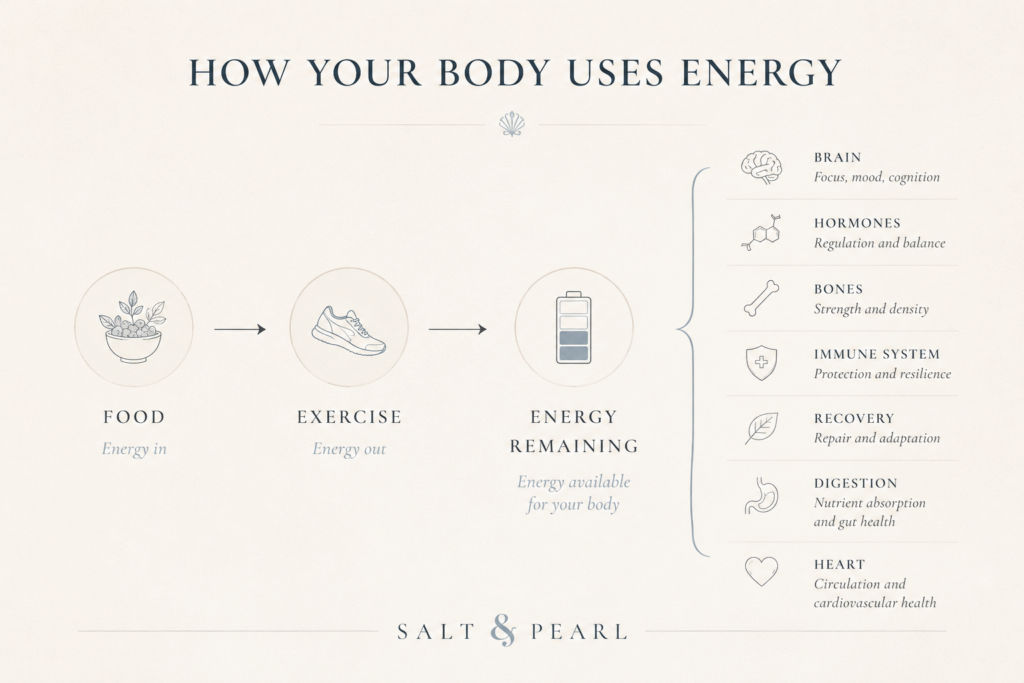
Think of your body like a cell phone. When the battery gets low, it asks if you want to turn on Low Power Mode. To conserve battery, your phone temporarily limits certain functions so it can keep running as long as possible.
REDs is your body’s version of Low Power Mode.
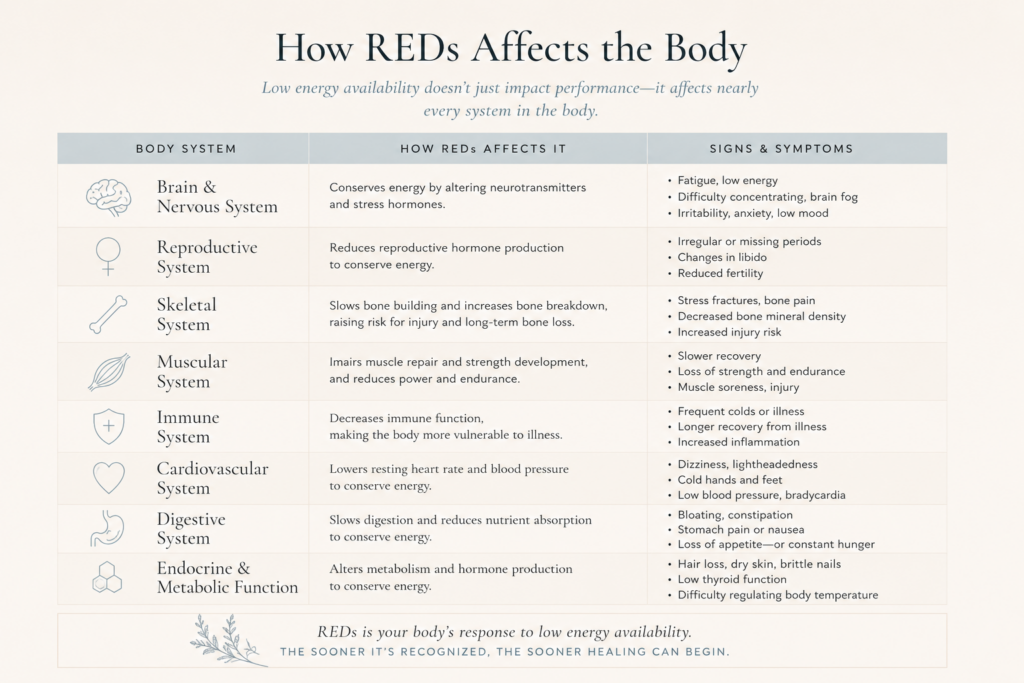
When you haven’t been eating enough to meet both your body’s daily needs and the energy demands of exercise, it begins conserving energy by dialing back functions that aren’t essential for immediate survival. Collagen production for healthy skin, hair, and nails slows. Reproductive function may be suppressed, leading to irregular or missing menstrual cycles. Bone remodeling, hormone production, immune function, and recovery can all be affected as your body tries to make the most of a limited energy supply.
Low Energy Availability
REDs doesn’t develop overnight, but it can begin surprisingly quickly. It’s caused by low energy availability (LEA)– a state in which your body doesn’t have enough energy left over after exercise to support normal physiological function.
Think of your body as operating on a tight budget.
Every day, it has to “pay” for everything it does: keeping your heart beating, repairing muscle, building bone, producing hormones, supporting your immune system, and fueling your workouts. When there isn’t enough energy to cover all of those costs, your body has to make difficult decisions.
Something has to give.
That’s when many women begin noticing symptoms.
Physiology Pearl
Your body doesn’t know if you’re training for something. It only knows if it has enough energy.
Although today’s world is filled with grocery stores and fully stocked kitchens, your brain evolved in an environment where food shortages were common. It doesn’t know there’s a refrigerator full of food just a few steps away. It only knows that the energy coming in isn’t matching the energy going out.
From your body’s perspective, it is preparing for a famine.
To help you survive, it begins conserving energy by reducing functions that aren’t immediately necessary for staying alive. These adaptations are remarkably intelligent in the short term, but when low energy availability persists, they can gradually lead to the wide range of health consequences we now recognize as REDs.
Who Can Get REDs?
The name Relative Energy Deficiency in Sport can be misleading. Don’t let the word sport fool you. You don’t have to be an elite athlete, or even consider yourself an athlete, to develop REDs.
In fact, many of my clients don’t identify as athletes at all. They don’t compete or race; they enjoy group fitness classes, cycle with friends on the weekends, or go for a run before work.
Whether you’re a runner, cyclist, lifter, weekend warrior, or simply someone trying to stay active while balancing work and family, your body doesn’t care what you call yourself.
It only knows whether it has enough energy.
Although it’s difficult to know exactly how many active women experience REDs, research suggests it is far more common than many people realize, particularly among endurance athletes and women participating in sports that emphasize leanness.
“But I’m not an elite athlete,” is something I hear often.
You don’t have to be. REDs isn’t determined by your performance level—it’s determined by the mismatch between the energy your body needs and the energy it’s receiving. You can be completely new to exercise and still develop REDs if you’re consistently underfueling.
Another common misconception is:
“But I’m not skinny.”
You don’t have to be underweight or have an eating disorder to develop REDs. People of all body sizes can experience low energy availability. In fact, you cannot diagnose REDs simply by looking at someone. The diagnosis is based on a person’s symptoms, medical history, training, and overall health—not their appearance.
The bottom line is simple:
Any physically active person can develop REDs, regardless of their age, body size, body shape, sport, or fitness level.
What Causes REDs?
REDs is caused by low energy availability (LEA)– a state in which your body doesn’t have enough energy to support both exercise and the essential functions that keep you healthy. Put simply, low energy availability means there isn’t enough energy left over after exercise to support the body’s normal functions. When your energy intake consistently falls short of your body’s needs, it begins making adaptations to conserve energy.
Sometimes this happens intentionally. Someone may be trying to lose weight by eating less, exercising more, or both.
But for most of my clients, that’s not the case.
More often, REDs develops gradually and unintentionally. Life gets busy. Lunch gets skipped. Training increases, but food intake stays the same. Sometimes appetite simply doesn’t keep pace with increased activity, so women don’t eat because they aren’t hungry. Other times they’re making nutritious food choices, but they’re not eating enough to meet the energy demands of their lifestyle.
Almost all of my clients are surprised to learn they’re underfueling. They weren’t trying to eat too little—they simply didn’t realize how much energy their bodies actually needed.
That’s what makes REDs so easy to miss.
It usually isn’t the result of one dramatic decision. Instead, it’s the accumulation of small, seemingly insignificant choices over weeks or months that gradually create a gap between the energy your body needs and the energy it’s receiving.
What Are the Signs and Symptoms of REDs?
REDs affects far more than athletic performance. Because every organ system requires energy, the symptoms can appear almost anywhere in the body, and no two people experience REDs in exactly the same way.
Why Is REDs Often Missed?
Perhaps the most frustrating aspect of REDs is that many women spend years searching for answers without anyone connecting the dots.
One appointment focuses on fatigue. Another addresses recurring injuries. A gynecologist evaluates a missing period. A dermatologist discusses hair loss. A physical therapist treats persistent tendon pain.
Each symptom is real. But they’re often treated as separate problems rather than different expressions of the same underlying issue.
To make matters more confusing, laboratory tests may appear normal, especially in the early stages. That doesn’t mean nothing is happening. It means the body is remarkably good at adapting and compensating for a lack of energy.
By the time obvious abnormalities appear, your body may have been conserving energy for months, or even years.
This is why looking at the bigger picture is so important.
Health isn’t simply the absence of abnormal blood work. It’s having a body that has enough energy to function, recover, and thrive, not merely survive.
Why Should You Care?
It’s easy to dismiss persistent fatigue, a missed menstrual cycle, or a nagging injury as the price of being active.
Many women do.
They push through one more workout, drink another cup of coffee, or convince themselves they’ll feel better after their next vacation or once life becomes a little less stressful.
But REDs is more than simply feeling tired.
Over time, chronic low energy availability can affect your bones, hormones, cardiovascular health, immune function, metabolism, and mental well-being. Left untreated, it may increase your risk of stress fractures, recurrent injuries, infertility, and osteoporosis among other things. It can also rob you of the very reason many women exercise in the first place: to feel healthy, strong, and energized.
The encouraging news is that REDs is often reversible, especially when it’s recognized early.
The sooner you understand what your body is trying to tell you, the sooner you can begin supporting it in the way it needs.
Your body isn’t asking you to stop being active.
It’s is asking for enough energy to keep doing the things you love- not just this season, but for years to come.
How Is REDs Diagnosed?
REDs can be difficult to diagnose and is often overlooked because its symptoms can mimic many other conditions. There isn’t a single blood test, scan, or screening tool that can definitively diagnose REDs. Instead, diagnosis relies on looking at the bigger picture.
If you think you may have REDs, it’s important to see a healthcare professional who is familiar with the condition and can evaluate your overall health, not just an individual symptom or injury.
The evaluation typically begins with a thorough medical history, including a review of your symptoms, menstrual history (if applicable), injury history, training volume, recent changes in activity, eating habits, and your relationship with food and exercise. Your healthcare provider will also perform a physical examination, including measuring your heart rate and blood pressure, and may order laboratory tests or imaging studies to rule out other medical conditions or assess complications such as nutrient deficiencies or low bone mineral density.
Because REDs affects multiple body systems, diagnosis often involves putting together many pieces of information rather than relying on a single test result.
The good news is that the earlier REDs is recognized, the sooner treatment can begin, and the better the chance of preventing long-term health consequences.
Can REDs Be Reversed?
In many cases, yes, but recovery looks different for everyone.
The human body is remarkably resilient. When it’s consistently given enough energy, many of the changes caused by REDs begin to improve. Energy levels often increase, workouts become more enjoyable, injuries heal more readily, and many women notice improvements in mood, sleep, and concentration. For women who have lost their menstrual cycle, its return is often an encouraging sign that the body once again has enough energy to support normal reproductive function.
Recovery, however, isn’t always immediate, and it isn’t always complete.
How long you’ve been experiencing low energy availability, the severity of the energy deficit, your age, training load, and your overall health all influence recovery. Some changes, such as hormone function, energy levels, and athletic performance, may improve relatively quickly once adequate fueling is restored. Others take considerably longer.
Bone health deserves special mention.
Bone is living tissue that is constantly being broken down and rebuilt. During REDs, that rebuilding process slows, increasing the risk of stress fractures and reducing bone mineral density over time. While restoring adequate energy availability can improve bone health and reduce the risk of future injury, bone mineral density does not always fully recover—particularly if REDs developed during adolescence or persisted for many years. Because most people build the majority of their lifetime bone mass during adolescence and early adulthood, prolonged underfueling during these critical years may result in lower peak bone mass that cannot be completely regained later in life.
The encouraging news is that it’s never too late to support your body.
Whether you’ve been experiencing symptoms for a few months or several years, improving your energy availability can meaningfully improve your health, recovery, performance, and quality of life. The earlier REDs is recognized and treated, the better the chances of preventing long-term complications.
Recovery isn’t about eating perfectly.
It’s about consistently giving your body the energy it has been asking for all along.
Frequently Asked Questions
Is REDs the same as an eating disorder?
No.
Although eating disorders can lead to REDs, many women with REDs do not have an eating disorder. They may simply be unintentionally underfueling relative to their activity level, training volume, or overall life demands.
Can recreational exercisers develop REDs?
Absolutely.
You don’t need to compete at an elite level, or even consider yourself an athlete, to develop REDs. Anyone who consistently doesn’t meet their body’s energy needs can experience low energy availability.
Can you have REDs if you’re not underweight?
Yes.
REDs occurs across the weight spectrum. Body size alone cannot determine whether someone is adequately fueled.
How long does recovery take?
Recovery is highly individual. Factors such as the duration of underfueling, training load, hormone status, sleep, stress, and overall health all influence the timeline. Many women begin noticing improvements in energy and recovery within weeks of consistently increasing their energy intake, while full recovery may take several months or longer.
Should I stop exercising?
It depends.
The best approach depends on your symptoms, training load, injury history, and overall health. For some women, adjustments to training may be appropriate while recovery is underway. Working with a healthcare professional familiar with REDs can help determine the safest plan for your individual situation.
How is REDs Treated?
The goal of REDs treatment is to restore adequate energy availability while helping you return to, or continue participating in, physical activity safely. Treatment isn’t simply about eating more. It’s about giving your body the energy it needs to support both health and performance.
Recovery often begins with surprisingly ordinary things: eating breakfast consistently, replacing the energy used during training, allowing enough time between hard workouts, and giving yourself permission to eat enough.
Ideally, REDs is treated by a multidisciplinary healthcare team, which may include:
- A physician who is knowledgeable about REDs and can monitor your overall health, identify complications, and guide medical management.
- A registered dietitian with experience treating REDs who can help you consistently meet your energy needs, fuel your training appropriately, and rebuild confidence around food.
- A psychologist or mental health professional, when appropriate, to address anxiety, perfectionism, disordered eating, compulsive exercise, or other factors that may contribute to low energy availability.
Recovery isn’t about eating perfectly. It’s about consistently giving your body the resources it has been asking for all along.
That often includes:
- Eating enough throughout the day, not just at dinner
- Fueling before and after exercise
- Matching your nutrition to your training demands
- Allowing adequate recovery between hard workouts
- Challenging the belief that eating less is always healthier
For many women, these changes feel uncomfortable at first. We’ve spent years celebrating pushing through fatigue, ignoring hunger, and believing that “healthy” always means eating less.
Recovery asks something different. It asks you to trust that fueling your body isn’t a sign of weakness, it’s the foundation of health, recovery, and long-term performance.
It’s the foundation of health, recovery, and long-term performance.
Final Thoughts
If there’s one thing I hope you take away from this article, it’s this:
Your body isn’t working against you. It’s responding to the information it’s receiving.
If you’ve been feeling exhausted, constantly hungry, getting injured more often, or simply not feeling like yourself, those symptoms deserve attention, not dismissal.
Recovery doesn’t begin with more discipline.
It begins with enough.
Ready to Feel Like Yourself Again?
If this article felt familiar, you don’t have to figure it out alone. Whether you’ve recently been diagnosed with REDs or you’re wondering if low energy availability could explain the symptoms you’ve been experiencing, individualized guidance can help you recover with confidence.
Together, we’ll create a practical, evidence-based plan that supports your health, your training, and your long-term well-being, without the confusion or guesswork.
If this article felt familiar, you don’t have to navigate recovery alone. Schedule a complimentary discovery call to learn how we can work together.
References & Further Reading
Consensus Statements
Mountjoy M, Ackerman KE, Bailey DM, et al
2023 International Olympic Committee’s (IOC) consensus statement on Relative Energy Deficiency in Sport (REDs)
British Journal of Sports Medicine 2023;57:1073-1098.https://bjsm.bmj.com/content/57/17/1073.long
Mountjoy M, Sundgot-Borgen JK, Burke LM, et al. Br J Sports Med
2018;52:687–697.
Mountjoy M, Sundgot-Borgen J, Burke L, et al
The IOC consensus statement: beyond the Female Athlete Triad—Relative Energy Deficiency in Sport (RED-S)
British Journal of Sports Medicine 2014;48:491-497.
Foundational Research
Loucks AB. *Energy Availability in Athletes*. Journal of Sports Sciences. 2011;29(Suppl 1):S7-S15.
0 Comments